

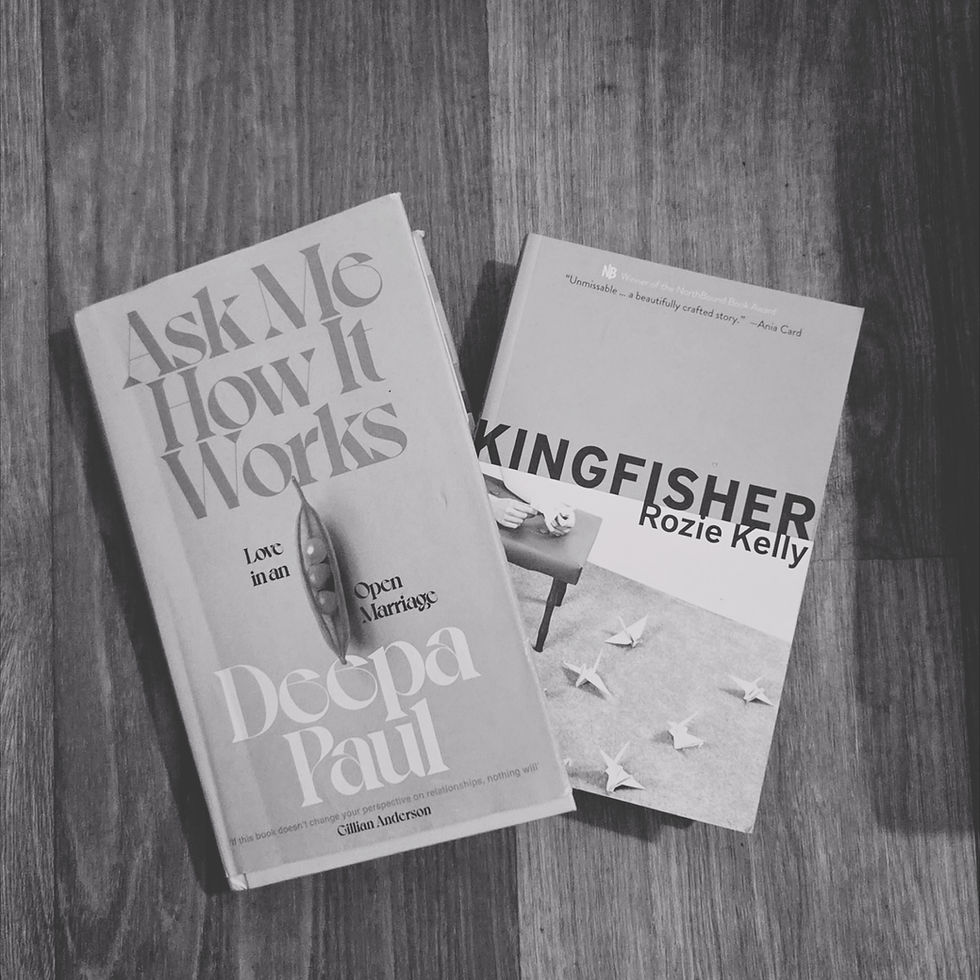
Women's Prize Mini Reviews - Ask Me How it Works and Kingfisher

Title: Ask Me How it Works*
Author: Deepa Paul
*This post contains affiliate links. If you make purchases after using these links, I will earn a percentage of your purchase without any further cost to you.
Rating: n/a (I don’t typically rate memoirs, but the writing in this was phenomenal)
Favorite Quote: “I learned that my body was an instrument of sin and must be hidden; and that good girls must obey by becoming less loud, less colourful, less troublesome – simply less.” Paul, Deepa. Ask Me How it Works. Viking, 2025, pg. 35.
Review: While I haven’t gotten through all of the nonfiction nominees yet, this one is certainly one of my favorites so far. Ask Me How it Works is a book about Paul’s experiences with polyamory and non-monogamy. Each chapter begins with a question - one she has, presumably, been asked a number of times - and each question is answered with an anecdote or exploration of how her life answers that question. The structure is working wonders to create what feels like a dialogue between Paul and the reader.
The contents, too, are gripping and keep the reader interested. This isn’t just a book about non-monogamy (although it would be okay if it was), it’s a comment on the author’s culture, on gender dynamics, on societal expectations. At its core, this book, while perhaps written in the form of a series of questions to the author, ultimately presents a series of questions to the reader. How do you view sexuality and exploration? What is your experience with gender (and gender violence)? What does parenthood mean in a non-traditional landscape?
Overall, this was a great addition to the Women’s Prize nominees and I am so glad I got the chance to read it.
About that Quote: Ultimately, I think this quote encompasses the idea that this book isn’t just about sex or relationships. This book is about the author’s experience, as well as the interconnectedness of gender, culture, sex, relationships, and all the ways in which those things influence one another.
(Incomplete) list of TWs for Ask Me How it Works: SA, sexism, racism, graphic sexual content
Title: Kingfisher
Author: Rozie Kelly
Rating: 4.75 stars / 5 stars
Favorite Quote: “That was one wall I tried to batter down, the wall of my intelligence, this abstract thing people kept using as a reason why I should be better than I was, than I am.” Kelly, Rozie. Kingfisher. Sarabrand, 2025, pg. 124.
Review: Kingfisher follows the protagonist as he, a seemingly gay man, falls in love with a (SPOILER ALERT) dying woman who happens to be an incredible poet who works at the university where he also works, but with far less acclaim.
Let’s talk about what’s working. Almost all of it. Frankly, I haven’t read a 5 stars / 5 stars book yet this year, but this one is so far the closest I’ve gotten. The characters are not particularly likeable, but in many ways that makes them more real. Insecurity (from the protagonist) and the fact that the poet is dying make them both contrary and at times cruel. But the reader still feels sympathy for them. They are not caricatures of the personalities they embody.
The symbolism, too, is beautiful - there’s a focus on nature, both in the book itself and paralleled in the poet’s writing and her decor.
Though short, this book feels complete. It starts where it should. It ends where it should. And almost everything in between happens as it should.
So why the .25 deficit? Frankly, even though I say this book feels complete, I do think there are some things that are extraneous. The narrator’s relationship with his mother is absolutely fundamental to who he is as a character. But, I don’t know that all the scenes with her are necessary to establish that dynamic. Similarly, the narrator’s relationship with his on again, off again partner, while also fundamental to how he ultimately becomes drawn to the poet, could use a scene or two less. (SPOILER ALERT) The scene, specifically, where they go to a restaurant and get high with some of the staff - that didn’t really do anything to propel the story forward.
About that Quote: The narrator’s self-worth is perhaps the single driving force of this novel, though it is, at times, subtle. His writing is obviously important to him, and as the novel progresses, his agent seems to think he is on the brink of success. But his (especially early) comparisons to the poet make him feel like he needs to be better. As do the flashbacks to his childhood, as it relates to his mother, and his tumultuous relationship with the man he is seeing at the beginning of the novel. This body encompasses that odd feeling that there are people in his life who think he should be better, but also, he thinks he should be better.
(Incomplete) list of TWs for Kingfisher: dr*g use, cancer, death


Comments